


Our Social Network
AI for Small Businesses: Real Use Cases in Customer Support, Marketing, Accounting, and Workflow Automation
 28 July 2026
 8 min read
AI for Small Businesses: Real Use Cases in Customer Support, Marketing, Accounting, and Workflow Automation
Learn how small businesses use AI in customer support, marketing, accounting, and workflow automation to save time, reduce costs, and improve productivity.
Introduction
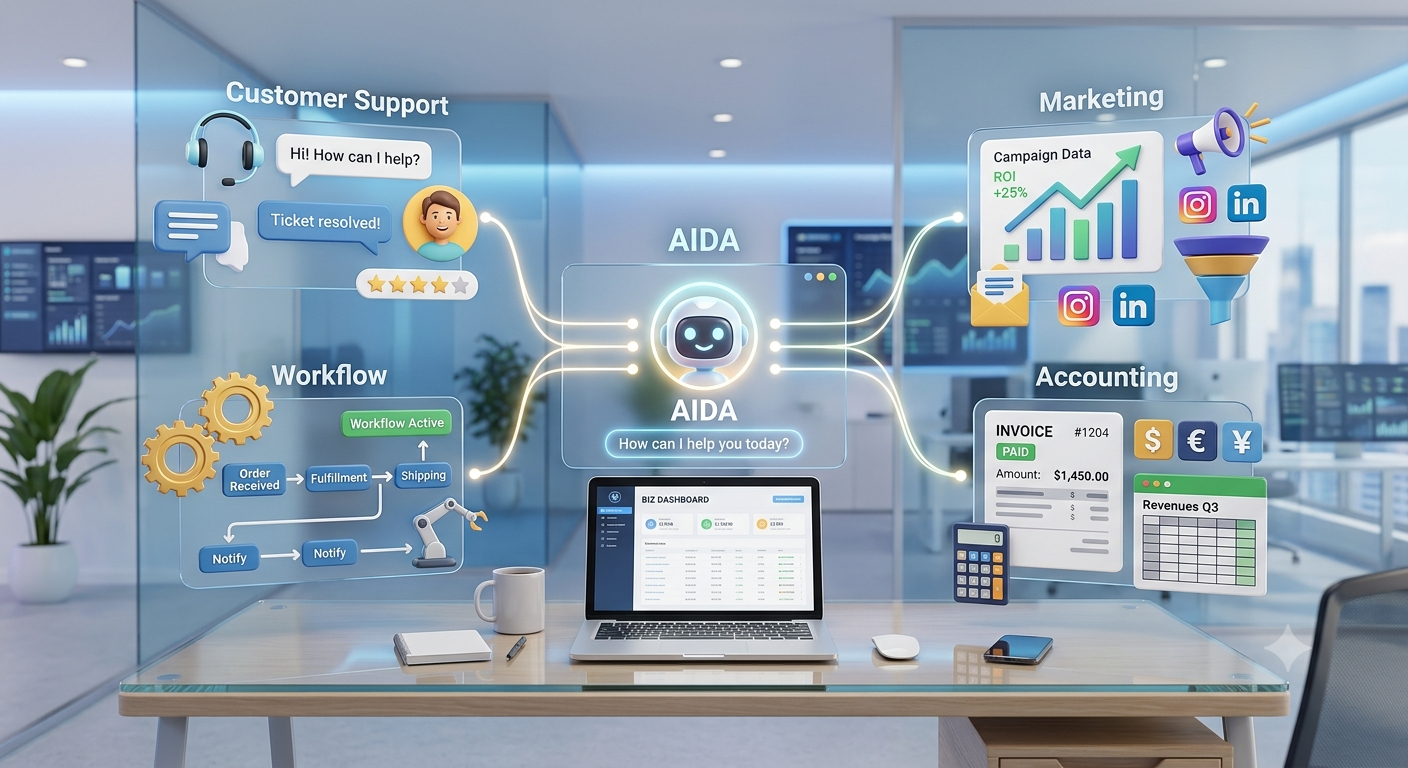
AI is no longer limited to large enterprises with big budgets. Small businesses are now using AI to handle repetitive tasks, improve customer experience, and make faster decisions across daily operations. The most practical use cases today are customer support, marketing, accounting, and workflow automation because they deal with high-volume, repetitive work that can be measured and improved quickly.
AI in customer support
Customer support is one of the strongest use cases for AI because businesses receive many similar questions every day. AI chatbots and support assistants can answer common queries, route tickets to the right person, summarize conversations, and help agents respond faster. This reduces response time, improves consistency, and lets human staff focus on complex customer issues.
For example, a small online store can use AI to answer questions about order status, refund policies, delivery timelines, and product availability. Instead of making customers wait for email replies, the business can provide instant support around the clock. This kind of automation improves customer satisfaction while lowering support workload.
AI in marketing
AI is also changing how small businesses plan and run marketing campaigns. It can help generate social media posts, suggest email subject lines, score leads, personalize messages, and analyze which campaigns are performing best. That means marketing teams can move faster and make better decisions without needing a large staff.
A local service business, for example, can use AI to draft promotional emails, create ad copy, and recommend the best time to post on social channels. It can also segment customers based on behavior and send more relevant offers. This makes marketing more efficient and often improves conversion rates.
AI in accounting
Accounting is another area where AI delivers clear value because many tasks are repetitive and rule-based. Businesses can use AI for invoice processing, expense categorization, payment reminders, and financial data extraction. These tools reduce manual data entry and lower the chance of human error.
A small business can, for example, scan invoices automatically, pull out key details, and organize them into accounting software. AI can also help identify unusual transactions or flag missing information before reports are finalized. This saves time for owners and finance teams while making bookkeeping more accurate.
AI in workflow automation
Workflow automation is where AI ties all the other use cases together. It can connect tools, move tasks between teams, summarize meetings, generate follow-up actions, and keep routine work moving without constant supervision. This is especially useful for small businesses that need to do more with fewer people.
For instance, when a new lead fills out a form, AI can automatically send a welcome email, create a task in the CRM, notify sales, and schedule a follow-up reminder. The same idea can be used for onboarding, approvals, reporting, and internal updates. When repetitive workflows are automated, teams spend less time on coordination and more time on growth.
Benefits for small businesses
The biggest benefit of AI is that it saves time while improving consistency. Small businesses can use it to reduce manual work, respond faster to customers, and make operations more efficient. It also helps teams scale without immediately adding more headcount.
Another major advantage is better decision-making. AI tools can surface trends, highlight bottlenecks, and summarize large amounts of data into usable insights. For business owners, this means less guesswork and more clarity about what is working.
Challenges to consider
AI is useful, but it should not be adopted blindly. Small businesses still need to review accuracy, protect customer data, and make sure automation does not create a poor customer experience. Human oversight remains important, especially in support, finance, and customer-facing workflows.
It is also better to start small rather than automate everything at once. Businesses should pick one high-impact process, test it, measure the results, and then expand gradually. This makes implementation easier and lowers the risk of disruption.
## Conclusion
AI is giving small businesses practical ways to improve customer support, marketing, accounting, and workflow automation. The best results come from using AI to handle repetitive work while people focus on decisions, relationships, and strategy. For many businesses, this is one of the fastest ways to save time and increase efficiency.
Leave a Reply
Share your thoughts about this article.

Mohammed Aman
Tech blogger covering AI, coding, and the future of software. Founder of CodeWithBeast.

More Articles

Claude AI vs ChatGPT vs Gemini: Which AI Assistant Wins in 2025?
The AI assistant landscape is more competitive than ever. Claude, ChatGPT, and Gemini each excel in ...

What is Vibe Coding? The AI Revolution Turning Everyone into a Developer
Vibe coding is the practice of building software by directing AI with natural language. Coined by An...

Top 10 Programming Languages to Learn in 2025 (Ranked by Demand)
Choosing the right programming language can make or break your career. Here are the top 10 languages...
Never Miss a Tech Article
Join thousands of developers getting the latest AI, coding, and tech tutorials delivered to their inbox every week.
CodeWithBeast is your hub for AI, coding, and the latest in tech. Empowering developers, creators, and learners worldwide.
© 2026 CodeWithBeast. All Rights Reserved.