


Our Social Network
AIOps in Cloud DevOps: The Future of Self-Healing, Predictive Operations
 19 July 2026
 8 min read
AIOps in Cloud DevOps: The Future of Self-Healing, Predictive Operations
AIOps is transforming cloud DevOps with predictive monitoring, self-healing automation, and smarter incident response, Learn how it reduces downtime.
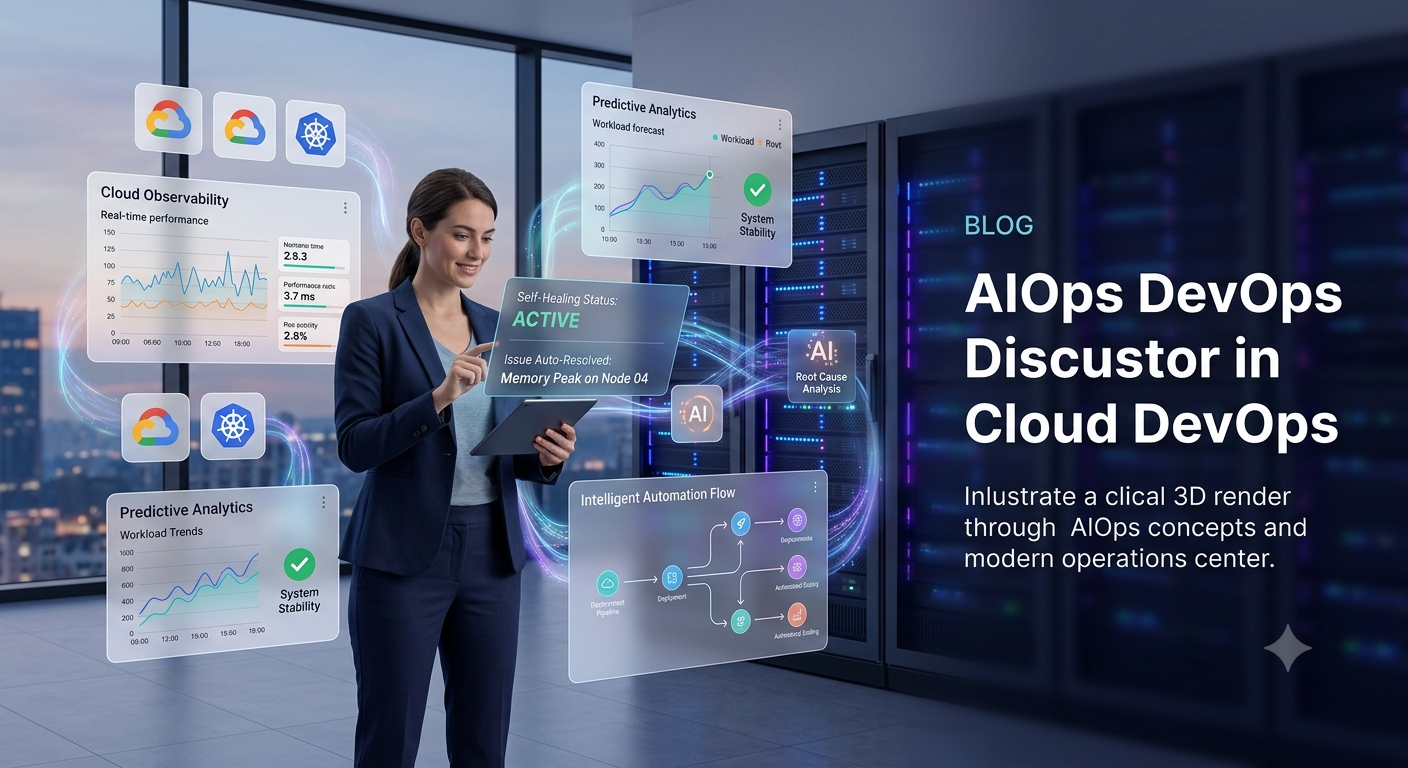
Cloud DevOps has evolved from a discipline focused mainly on deployment speed into a broader strategy for reliability, scalability, and resilience. As modern applications spread across Kubernetes, microservices, serverless platforms, multi-cloud environments, and edge systems, the operational complexity increases sharply. Traditional manual monitoring and reactive troubleshooting are no longer enough to keep systems stable at scale [web:37][web:41][web:43].
This is where AIOps, or Artificial Intelligence for IT Operations, is becoming a major force. AIOps applies machine learning, anomaly detection, event correlation, and predictive analytics to help teams detect issues earlier and automate responses faster. In cloud DevOps, it is changing how organizations think about uptime, incident management, and infrastructure health [web:38][web:40][web:41].
What is AIOps?
AIOps is the use of AI and data analytics to improve IT operations. It works by collecting and analyzing large volumes of telemetry data, such as logs, metrics, traces, deployment events, and infrastructure signals, then using AI models to identify patterns, detect anomalies, and recommend actions [web:37][web:41].
Instead of relying on humans to manually review every alert and dashboard, AIOps platforms help teams process operational noise at scale. The real value is not only in faster detection, but also in better understanding of what is happening inside complex cloud systems [web:38][web:41].
Why AIOps Matters in Cloud DevOps
Cloud DevOps teams deal with huge amounts of data from multiple tools and environments. A single incident can create dozens or even hundreds of alerts, making it difficult to find the real cause quickly. AIOps helps cut through this noise by correlating signals and highlighting what truly matters [web:37][web:41].
It also matters because cloud systems are dynamic. Resources scale up and down, workloads shift, deployments happen frequently, and dependencies change constantly. In that kind of environment, predictive automation is far more effective than waiting for something to fail and then reacting after the damage is already done [web:37][web:38].
### Predictive Operations Explained
Predictive operations is the shift from reactive support to proactive prevention. Instead of telling engineers that a system has already broken, AIOps looks for patterns that suggest a future failure. These patterns may include rising latency, memory pressure, unusual error rates, or abnormal traffic behavior [web:37][web:41].
For example, if a service begins to consume more CPU over time and the error rate slowly increases, an AIOps platform can flag that trend before it becomes an outage. This gives teams time to investigate, tune capacity, or roll back a risky deployment before users are impacted [web:37][web:38].
Self-Healing Systems
Self-healing is one of the most valuable outcomes of AIOps. When a platform detects a known issue, it can trigger an automated fix without requiring a human to step in first. That may include restarting unhealthy pods, rolling back a faulty release, rebalancing workloads, scaling services, or applying configuration changes [web:38][web:41].
This is especially powerful in Kubernetes and cloud-native environments, where services can recover quickly if the right automation is in place. Self-healing reduces downtime, lowers the burden on operations teams, and improves overall system resilience. The key is to pair automation with safe guardrails so the system stays reliable and predictable [web:40][web:42].
Common AIOps Use Cases
AIOps is not just a theory. It already has practical uses in cloud DevOps teams.
Incident Prediction
AIOps can analyze historical and live telemetry to spot early warning signs before an outage happens. This helps teams take action earlier and reduce the chance of service disruption [web:37][web:41].
Root Cause Analysis
When something breaks, the hardest part is often figuring out why. AIOps helps by correlating logs, traces, metrics, and deployment changes so teams can move from symptom chasing to root cause identification much faster [web:37][web:40].
Automated Remediation
Once a problem is recognized, AIOps can trigger scripts or workflows to resolve it automatically. These workflows may restart services, scale capacity, revert deployments, or apply policy corrections [web:38][web:41].
Noise Reduction
Large systems often create too many alerts. AIOps filters duplicate and low-value alerts so engineers can focus on incidents that actually need attention [web:37][web:41].
Cost Optimization
AIOps can also help with cloud cost efficiency by identifying waste, idle resources, overprovisioned workloads, and inefficient scaling. This is where AIOps and FinOps begin to overlap in a very practical way [web:41][web:43].
AIOps and FinOps
AIOps and FinOps make a strong combination because they both aim to improve cloud efficiency. FinOps focuses on controlling cloud spend, while AIOps helps analyze operational and usage data to find opportunities for savings [web:41][web:43].
For instance, if a workload is oversized for its actual traffic, AI can recommend rightsizing. If a development environment stays active longer than needed, AIOps can surface that inefficiency. If scaling patterns are too aggressive, AI can identify that the cost increase is not justified by performance needs [web:41].
This connection is important because modern cloud operations are not only about stability. They are also about using resources intelligently and reducing waste wherever possible [web:37][web:41].
The Observability Layer
AIOps depends heavily on observability. The quality of the telemetry data directly affects the quality of the insights. If logs are incomplete, traces are missing, or events are disconnected, the AI engine has less context to work with [web:37][web:43].
That is why mature AIOps implementations often sit on top of strong observability platforms. Logs, metrics, traces, events, and deployment records all need to be connected so the system can understand what changed, what broke, and what action should happen next [web:37][web:41].
### Why Cloud Teams Are Adopting AIOps
Cloud teams are adopting AIOps because the old way of operating systems is too slow for modern environments. Manual monitoring does not scale well when services are deployed daily, traffic patterns shift often, and failures can spread across interconnected systems in minutes [web:37][web:42].
AIOps helps teams move faster with less friction. It improves incident response, reduces alert fatigue, supports 24/7 operations, and gives engineers more time to work on higher-value tasks instead of repetitive firefighting [web:38][web:41].
### Benefits for DevOps Teams
AIOps brings several clear benefits to DevOps and SRE teams.
- It reduces mean time to detect because anomalies can be flagged early.
- It reduces mean time to recover because the system can recommend or execute fixes faster.
- It lowers alert noise, which improves focus and reduces burnout.
- It improves uptime by catching issues before they spread.
- It supports better cloud efficiency through automated optimization [web:37][web:38][web:41].
These benefits make AIOps especially attractive in organizations that are scaling quickly or managing complex production environments.
### Challenges and Risks
Even though AIOps is powerful, it is not perfect. If the input data is poor, the recommendations will also be weak. That means organizations need reliable telemetry pipelines and good observability foundations before expecting strong results [web:37][web:40].
Another challenge is trust. Engineers need to understand why an AI system made a decision, especially if it triggers an automated action. Without explainability and strong guardrails, teams may hesitate to rely on the automation [web:38][web:41].
There is also the risk of over-automation. Not every issue should be handled automatically. Some incidents need human judgment, especially when the business impact is high or the root cause is uncertain [web:37][web:43].
### Future of AIOps in Cloud DevOps
The future of cloud DevOps is clearly moving toward more autonomous operations. The current trend across industry discussions in 2026 is toward self-healing systems, predictive analytics, intelligent observability, and AI-assisted remediation [web:37][web:38][web:44].
As these systems mature, engineers will likely spend less time manually handling repetitive incidents and more time defining policies, building guardrails, and improving system design. In other words, operations will become more strategic and less reactive [web:37][web:42].
This shift also means that future DevOps professionals will need a stronger mix of cloud, automation, observability, and AI literacy. The most valuable teams will be the ones that can combine human judgment with machine-driven speed [web:41][web:43].
### Real-World Example
Imagine a Kubernetes-based e-commerce platform during a traffic spike. A microservice begins to slow down, error rates rise, and customer checkout latency increases. In a traditional setup, the on-call engineer may receive multiple alerts, inspect dashboards, check logs, and then manually decide what to do [web:38][web:41].
With AIOps, the platform can detect the abnormal pattern early, correlate the issue with a recent deployment, and trigger an automated rollback or scaling action. That means the outage may be avoided entirely, or at least resolved much faster than with manual intervention [web:37][web:40][web:41].
### Conclusion
AIOps is becoming a core part of cloud DevOps because it helps teams operate systems that are too complex for manual management alone. It brings prediction, automation, and self-healing into the operational workflow, making infrastructure more resilient and efficient [web:37][web:38][web:41].
For organizations that want better uptime, lower cost, and faster incident response, AIOps is not just an emerging trend. It is a practical direction for the future of modern cloud operations [web:37][web:43].
Leave a Reply
Share your thoughts about this article.

Mohammed Aman
Tech blogger covering AI, coding, and the future of software. Founder of CodeWithBeast.

More Articles
Claude AI vs ChatGPT vs Gemini: Which AI Assistant Wins in 2025?
The AI assistant landscape is more competitive than ever. Claude, ChatGPT, and Gemini each excel in ...

What is Vibe Coding? The AI Revolution Turning Everyone into a Developer
Vibe coding is the practice of building software by directing AI with natural language. Coined by An...
Top 10 Programming Languages to Learn in 2025 (Ranked by Demand)
Choosing the right programming language can make or break your career. Here are the top 10 languages...
Never Miss a Tech Article
Join thousands of developers getting the latest AI, coding, and tech tutorials delivered to their inbox every week.
CodeWithBeast is your hub for AI, coding, and the latest in tech. Empowering developers, creators, and learners worldwide.
© 2026 CodeWithBeast. All Rights Reserved.